
If you’re self-employed in the United States — freelancing, consulting, driving for a rideshare app, or running any unincorporated business — you owe a tax that W-2 employees never see itemized on a pay stub. It’s called self-employment tax, and for 2027 the headline number is the same as it’s been for years: 15.3%. Put another way, the self-employment tax rate 2027 is identical to 2026’s.
Table of Contents
But that single number hides a two-part structure, a $192,300 earnings cap, a 92.35% quirk in the math, and a high-income surtax most freelancers have never heard of. This guide breaks down the self-employment tax rate 2027 — what changed, how to calculate it, and what it actually costs at different income levels, with worked examples.
Self-Employment Tax Rate 2027: The Short Answer
The self-employment tax rate 2027 is 15.3% of your net earnings, made up of:
- 12.4% for Social Security — applies only to the first $192,300 of earnings (the 2027 Social Security wage base, up from $184,500 in 2026)
- 2.9% for Medicare — applies to all net earnings, with no cap
Earn more than $200,000 as a single filer ($250,000 married filing jointly) and an additional 0.9% Medicare tax applies to the excess. The tax kicks in once your net earnings from self-employment reach $400, and you calculate it on IRS Schedule SE.
What’s Inside the Self-Employment Tax Rate 2027: The 15.3% Breakdown
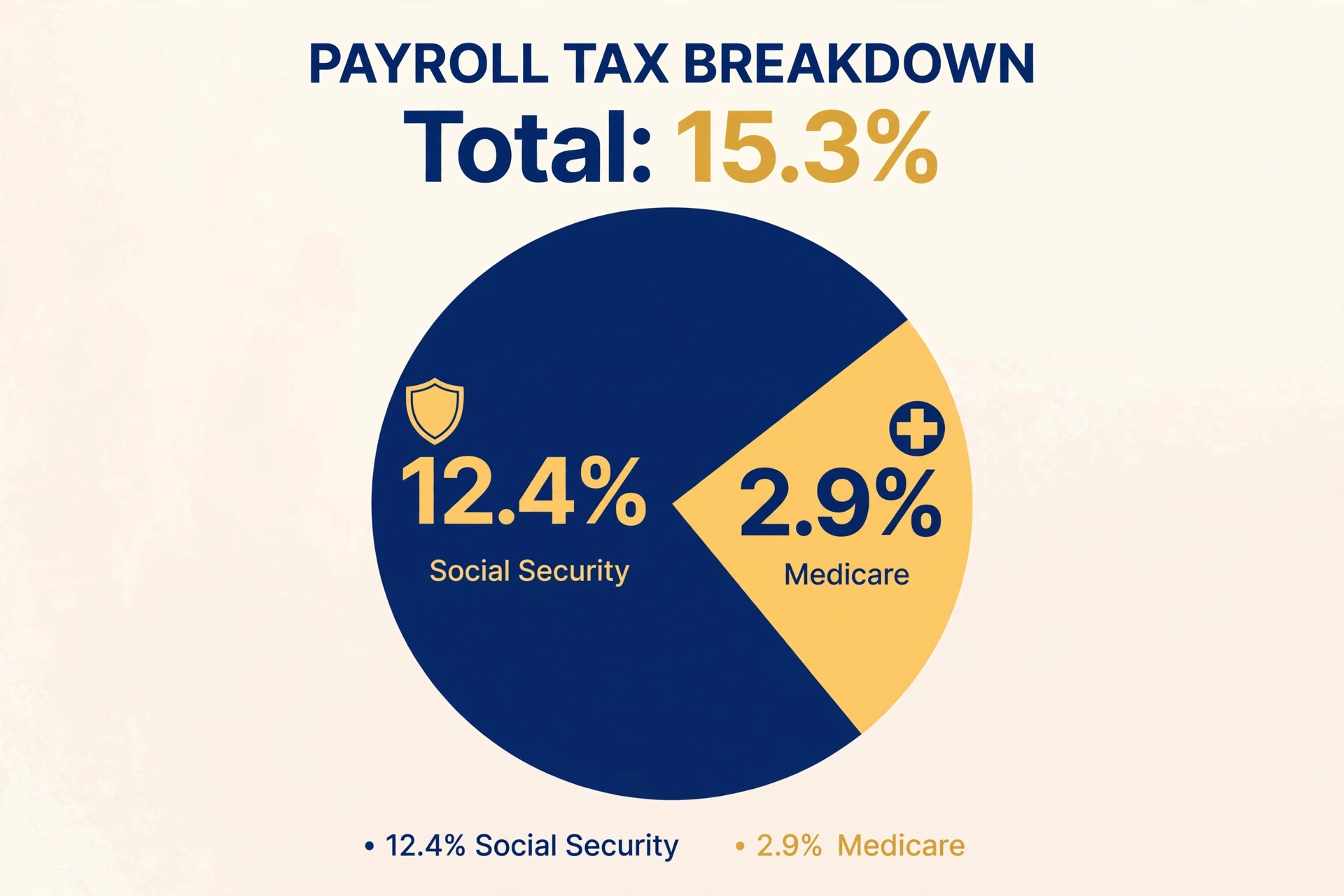
Self-employment tax is the freelancer’s version of the payroll taxes that fund Social Security and Medicare. When you’re an employee, your employer withholds 7.65% from your paycheck (6.2% Social Security + 1.45% Medicare) and pays a matching 7.65% out of its own pocket. When you’re self-employed, you’re both the employer and the employee — so you pay both halves: 7.65% + 7.65% = 15.3%.
| Component | Employee pays | Employer pays | Self-employed pays |
|---|---|---|---|
| Social Security | 6.2% (up to $192,300) | 6.2% (up to $192,300) | 12.4% (up to $192,300) |
| Medicare | 1.45% (no cap) | 1.45% (no cap) | 2.9% (no cap) |
| Total | 7.65% | 7.65% | 15.3% |
These rates are set by federal statute and did not change for 2027. What did change is the Social Security wage base — the amount of earnings subject to the 12.4% piece.
The 2027 Social Security Wage Base: $192,300
Each October, the Social Security Administration adjusts the maximum earnings subject to Social Security tax based on national average wage growth. On October 14, 2026, the SSA announced that the 2027 wage base rises to $192,300 — a $7,800 increase from the 2026 base of $184,500.
What that means in dollars:
- Maximum Social Security tax a self-employed person can owe in 2027: $192,300 × 12.4% = $23,845.20 (up from $22,878.00 in 2026)
- If you earn less than the old 2026 cap ($184,500): you pay nothing extra in 2027 — your Social Security tax only rises if your own earnings rise
- If you’re above the cap: you pay at most $967.20 more in the Social Security portion than in 2026 ($7,800 × 12.4%)
The Medicare portion (2.9%) has no earnings limit — every dollar of net earnings is subject to it, at every income level.
How to Calculate the Self-Employment Tax Rate 2027 (Step by Step)
Calculating your self-employment tax involves a quirk that surprises almost every new freelancer: you don’t pay it on 100% of your profit. The IRS lets you exclude 7.65% — the employer half — before multiplying, so the tax applies to 92.35% of your net earnings. That adjustment partially compensates for the fact that employees never pay payroll tax on the employer’s matching contribution. Once you understand the moving parts, the self-employment tax rate 2027 is straightforward to estimate.
Here’s the process (this is what Schedule SE does behind the scenes):
- Start with net earnings: gross business income minus deductible business expenses (your Schedule C profit).
- Multiply by 92.35% to get net earnings subject to SE tax. (Skip the tax entirely if this is under $400.)
- Multiply by 15.3% — but apply the 12.4% Social Security piece only up to the $192,300 cap; the 2.9% Medicare piece applies to all of it.
- Deduct half the result from your gross income on Form 1040 (Schedule 1) — more on this below.
Worked Example: $80,000 in Net Freelance Profit
Step 1 — Find the taxable base. $80,000 × 92.35% = $73,880 in net earnings subject to SE tax.
Step 2 — Social Security piece. $73,880 × 12.4% = $9,161.12. (Well under the $192,300 cap, so no cap math needed.)
Step 3 — Medicare piece. $73,880 × 2.9% = $2,142.52. (No cap on Medicare.)
Step 4 — Total. $9,161.12 + $2,142.52 = $11,303.64 in self-employment tax — an effective rate of about 14.1% of the original $80,000 profit.
Notice the effective rate (14.1%) comes in below the headline 15.3% — that’s the 92.35% factor doing its quiet work.
See how the 25–30% tax set-aside rule covers this plus income tax.
What Changes at High Incomes: The Cap and the 0.9% Surtax
Two things kick in as freelance income climbs past six figures.
First, the Social Security portion stops growing. Once your net earnings pass $192,300, you owe no more Social Security tax for the year — the maximum possible is $23,845.20. Because of the 92.35% factor, a freelancer with no W-2 wages hits the cap at about $208,230 in Schedule C profit ($192,300 ÷ 92.35%).
Second, the Additional Medicare Tax starts. Net self-employment earnings above $200,000 for single filers (or $250,000 for married couples filing jointly, $125,000 for married filing separately) are hit with an extra 0.9% Medicare tax — on top of the regular 2.9%.
Worked Example: $230,000 in Net Freelance Profit (Single Filer)
Step 1 — Taxable base. $230,000 × 92.35% = $212,405.
Step 2 — Social Security piece. Capped: $192,300 × 12.4% = $23,845.20.
Step 3 — Medicare piece. $212,405 × 2.9% = $6,159.75.
Step 4 — Additional Medicare Tax. ($212,405 − $200,000) × 0.9% = $12,405 × 0.9% = $111.65.
Total: $23,845.20 + $6,159.75 + $111.65 = $30,116.60 — an effective rate of about 13.1% of profit, lower than the mid-income freelancer’s rate because the Social Security portion maxed out. This is the rare case where the tax code gets less painful per dollar as you earn more.
The Two Breaks People Miss: 92.35% and the Half-Tax Deduction
We’ve covered the 92.35% factor. The second break is equally important: you can deduct half of your self-employment tax from your gross income. It’s an above-the-line deduction on Form 1040 (Schedule 1), so it lowers your adjusted gross income even if you take the standard deduction.
In the $80,000 example, that’s a $5,651.82 deduction ($11,303.64 ÷ 2). If you’re in the 22% federal income tax bracket, that deduction alone saves you roughly $1,243 in income tax — which meaningfully offsets the sting of paying “both halves.”
The policy logic is straightforward: an employee never pays income tax on the employer’s payroll-tax contribution, so the self-employed get this deduction to keep the playing field level.
Self-Employment Tax vs. Income Tax: Not the Same Thing
This is the single most common point of confusion for new freelancers. Self-employment tax and federal income tax are two entirely separate taxes:
| Self-employment tax | Federal income tax | |
|---|---|---|
| What it funds | Social Security + Medicare | General government spending |
| 2027 rate | 15.3% (12.4% capped + 2.9% uncapped) | Graduated brackets: 10%–37% |
| Applies to | 92.35% of net earnings ≥ $400 | Taxable income after deductions |
| Form | Schedule SE | Form 1040 |
| You owe it even if… | you owe zero income tax | — |
You can owe self-employment tax while owing no income tax at all — for example, if deductions bring your taxable income to zero, you still owe the 15.3% on your net earnings. That’s why setting aside 25–30% of every payment matters: the SE tax alone guarantees a double-digit tax bill on virtually any profitable freelance work.
What If You Also Have a W-2 Job?
Side-hustlers and part-time freelancers get one piece of good news: W-2 wages use up the $192,300 Social Security wage base first. Self-employment income only gets taxed for Social Security on the remaining room.
Say you earn $150,000 in W-2 wages and $60,000 in freelance profit in 2027:
- Your employer already paid Social Security tax on the first $150,000, leaving $42,300 of base for your freelance income.
- Your SE net earnings: $60,000 × 92.35% = $55,410.
- Social Security piece: only the first $42,300 of that is subject to 12.4% ($5,245.20); the remaining $13,110 is exempt from the Social Security portion.
- The full $55,410 is still subject to the 2.9% Medicare piece ($1,606.89).
Schedule SE handles this coordination automatically — but you need to know your W-2 earnings to sanity-check the result.
Self-Employment Tax Rate 2027 vs. 2026: What Changed
| 2026 | 2027 | Change | |
|---|---|---|---|
| Total SE tax rate | 15.3% | 15.3% | None (set by statute) |
| Social Security wage base | $184,500 | $192,300 | +$7,800 |
| Max SS tax (self-employed) | $22,878.00 | $23,845.20 | +$967.20 |
| Additional Medicare Tax threshold | $200k / $250k | $200k / $250k | None |
| 92.35% factor / $400 threshold | Same | Same | None |
Bottom line: the self-employment tax rate 2027 is unchanged — only the cap moved. If your freelance income stays under roughly $184,500, your 2027 self-employment tax math looks essentially identical to 2026.
FAQ
Does the self-employment tax rate 2027 apply to all my income?No — it applies to your net earnings (profit after business expenses), and only 92.35% of that. Income tax is calculated separately on your taxable income, so your total tax bill is always higher than 15.3% once income tax is included.
Is the self-employment tax rate the same in every state?
Yes. Self-employment tax is a federal tax with the same 15.3% rate in all 50 states. States don’t add their own version — though state income tax comes on top where it exists.
Do I pay self-employment tax on my first freelance gig?
You owe it once your net earnings from self-employment reach $400 in a year. Below that threshold, no Schedule SE is required — though you still report the income.
Can I reduce my self-employment tax legally?
Yes, in two main ways: (1) claim every legitimate business deduction — the tax is calculated on profit, so each dollar of expenses cuts both SE tax and income tax; and (2) at higher incomes, electing S-corporation taxation can reduce the earnings subject to SE tax — a strategy worth discussing with a CPA once profits are consistently above roughly $60,000–$80,000.
This article is for general information only and is not tax, legal, or financial advice. Tax rules depend on your individual situation and change over time — consult a licensed tax professional before making decisions based on this information.