
Do Freelancers Need an EIN? When to Get One (and When to Skip It)
Do freelancers need an EIN? Short answer: not usually. If you’re a sole proprietor with no employees, the IRS does not require you to have an Employer Identification Number — your Social Security number works just fine for filing your taxes. But “not required” and “not worth getting” are two very different things. For most freelancers, an EIN is one of the highest-value fifteen minutes you’ll ever spend: it’s free, it’s instant, and it keeps your Social Security number out of strangers’ accounting systems.
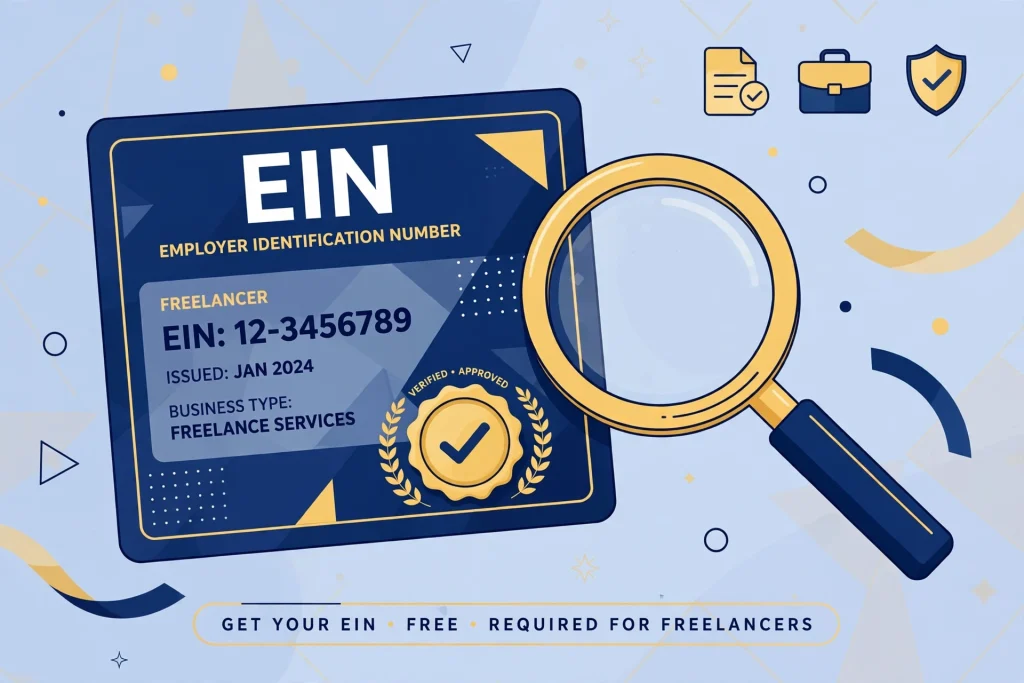
Table of Contents
Still asking yourself ‘do freelancers need an EIN’? This guide covers exactly when an EIN is legally required, the six practical reasons freelancers get one anyway, when you can safely skip it, and how to get yours free from the IRS without falling for the scam sites that charge for it.
Do Freelancers Need an EIN? The Quick Answer: No — But Get One Anyway
As a freelancer operating as a sole proprietor with no employees, you can legally run your entire business using your Social Security number (SSN). The IRS explicitly says a sole proprietor with no employees doesn’t need one — you can use your SSN or an EIN. That gap between ‘not required’ and ‘strongly recommended’ is exactly why ‘do freelancers need an EIN’ is such a common question.
So why does almost every tax professional recommend getting one? Because an EIN:
- Keeps your SSN off the W-9s you hand to every client
- Unlocks business bank accounts (most banks require one)
- Is free and takes about 15 minutes at IRS.gov
- Prepares you for growth: hiring, forming an LLC, issuing 1099s
Think of it less like a requirement and more like a seatbelt: not legally necessary to sit in the passenger seat, but foolish to skip. Most freelancers asking ‘do freelancers need an EIN’ end up getting one for the privacy alone.
When Do Freelancers Need an EIN? (Legally Required Cases)
There are specific situations where the IRS requires you to have one. If any of these apply to you, don’t skip it.
| Situation | Why the EIN is required |
|---|---|
| You hire employees | You can’t file employment tax returns (Forms 940 and 941) or issue W-2s without one |
| You hire independent contractors | As the payer filing 1099-NECs, your EIN identifies you on every information return — an SSN won’t cut it here |
| You set up a Solo 401(k) or Keogh plan | Retirement plans for the self-employed require an EIN |
| You file excise tax returns (e.g., Form 720) | The IRS requires an EIN for excise filings |
| You form a corporation, partnership, or multi-member LLC | These are legally separate from you and need their own federal tax ID |
| Your single-member LLC elects S-corp or C-corp taxation | Once the LLC elects corporate tax treatment, it needs its own EIN regardless of employees |
| You buy or inherit an existing business | A change of ownership means a new EIN |
The most common trigger for freelancers is the second one: hiring subcontractors. Many solo freelancers eventually outsource overflow work to other freelancers. The moment you’re the one paying people and filing 1099s, you need an EIN as the payer — even though you’re still a sole proprietor yourself (see 1099-NEC vs 1099-MISC: Which One Should Freelancers Expect?). If you’ve been asking ‘do freelancers need an EIN’ only once you hire — this is the moment the answer becomes yes.
What about single-member LLCs?
This is where freelancers get tripped up most. If you formed a single-member LLC that the IRS treats as a disregarded entity (the default), you generally use your personal SSN for income tax purposes — the LLC doesn’t need its own EIN. But:
- If your LLC hires employees, the LLC itself needs an EIN to report and pay employment taxes (the IRS treats the LLC as a separate entity for employment tax, even while ignoring it for income tax).
- If your LLC elects S-corp or C-corp taxation, it needs its own EIN, period.
- When a client sends you a W-9, you still provide your SSN or EIN as the owner — not the LLC’s EIN.
6 Practical Reasons to Get an EIN (Even When It’s Optional)
1. Protect your Social Security number
This is the single best reason. Every time you fill out a W-9 for a new client, you hand over a taxpayer identification number — and without an EIN, that number is your SSN. It then sits in the client’s accounting system, their accountant’s files, and possibly their cloud storage, indefinitely. One data breach at any of those companies and your personal identity is exposed. Using an EIN on your W-9 instead is one of the simplest privacy moves available to a freelancer, and the IRS accepts it without question.
2. Open a business bank account
Many banks require an EIN before they’ll open a business checking account — even for a sole proprietor. And you absolutely want that separate account: mixing personal and business money is the fastest way to make tax time miserable and the surest way to raise eyebrows in an audit. A dedicated account is the foundation of clean bookkeeping.
3. Look (and feel) like a real business
Clients notice. An EIN on your W-9, invoices, and contracts signals that you’re a professional operation, not someone doing a side gig. It’s a small credibility signal, but it’s free, and it costs you nothing to send.
4. You’re ready the moment you hire help
The first time you hire a virtual assistant, a subcontractor designer, or an editor, you’ll need an EIN to pay them properly and file their 1099-NECs. Getting it now means no scramble later — and it takes fifteen minutes.
5. Start building business credit
An EIN lets you establish a credit profile for your business that’s separate from your personal credit. Business credit cards, vendor accounts, and (later) financing all key off the EIN. If you ever plan to grow beyond a one-person shop, starting this early is pure upside.
6. Some states and licenses require it anyway
Even when federal law doesn’t demand an EIN, several states require one for state tax registration, and some local licensing offices ask for it on permit applications. Getting one preempts the paperwork.
When You Can Safely Skip It
There are exactly two conditions for skipping an EIN entirely:
- You have no employees and don’t hire contractors — nobody’s tax paperwork flows from you.
- You’re comfortable using your SSN on every W-9 — and your bank doesn’t require an EIN for your account.
If both are true — say you’re a solo designer with three long-term clients, all paying you on 1099s, with no plans to scale — you can legally operate on your SSN indefinitely. But note: the moment condition #1 changes (you hire your first VA), you’ll need an EIN that same week. Most people just get it upfront.
Quick decision checklist
Still wondering ‘do freelancers need an EIN’? Ask yourself these five questions. A single ‘yes’ means get one:
- ☐ Do you have (or plan to hire) employees or contractors?
- ☐ Do you want a business bank account?
- ☐ Do you send W-9s to clients and want your SSN out of their files?
- ☐ Do you have a Solo 401(k) or plan to open one?
- ☐ Did you form (or will you form) an LLC, S-corp, or partnership?
For most freelancers, the W-9 privacy question alone is reason enough. Still asking ‘do freelancers need an EIN’? The free 15-minute application makes it cheap insurance.
How Do Freelancers Get an EIN? Free in About 15 Minutes
Step 1: Go to IRS.gov — and only IRS.gov. The IRS does not charge for EINs, and you should never pay anyone to get one. The FTC has warned about look-alike websites charging fees for this free service, some collecting your Social Security number in the process. If a site asks for your credit card to “file” an EIN application, close the tab.
Step 2: Use the online EIN Assistant. It’s the fastest method — your EIN is issued instantly upon completion, and your confirmation letter is generated online for you to print or save. The tool runs seven days a week (Eastern Time): Monday–Friday 6:00 a.m.–1:00 a.m. (next day), Saturday 6:00 a.m.–9:00 p.m., and Sunday 6:00 p.m.–midnight. (The IRS expanded these hours in 2026 — many older guides still say weekdays only.) Fax and mail are also options, but take days to weeks.
Step 3: Have this information ready.
- Your legal name and SSN (or ITIN) as the responsible party — that’s you, the owner
- Your business name (or your own name, if you operate under it) and any DBA/trade name
- Business address, entity type (e.g., sole proprietorship), and reason for applying
- A brief description of your business activity and its start date
Step 4: Complete the application in one session. The tool times out after about 15 minutes and you can’t save mid-way. The IRS limits you to one EIN per responsible party per day, so plan accordingly if you’re forming multiple entities.
Step 5: Save your EIN immediately. It’s displayed once on screen along with your confirmation letter (Form CP 575) — print it or save the PDF before closing your browser, because the IRS issues the original only once and can’t reissue it. If you applied by fax or mail, the CP 575 arrives by post instead. Banks and payment processors often want to see this letter, so store it somewhere safe.
What to Do After You Get Your EIN
Once you’ve settled the ‘do freelancers need an EIN’ question, getting the number is the easy part. Here’s what to update:
- Use it on all future W-9s — start giving clients the EIN instead of your SSN.
- Open a business bank account (if you haven’t) — bring your EIN confirmation letter.
- Update your invoices and contracts with the EIN where a tax ID is shown.
- Set up payroll or 1099-filing capability if you hired people — you now have what those filings need.
- Store the CP 575 letter somewhere safe — it’s the official record of your EIN; lenders and banks may ask for it.
You don’t need to reissue old W-9s or amend past tax returns. Just use the EIN going forward.
FAQ
Do freelancers need an EIN to file taxes?
No — not if you’re a sole proprietor with no employees. You file Schedule C with your Form 1040 using your SSN. An EIN remains a practical choice for most freelancers (privacy, banking, hiring), but it’s not a filing requirement. So do freelancers need an EIN to file taxes? Only in the required cases above.
Can I get an EIN as a sole proprietor with no employees?
Yes. The IRS lets any business entity apply, including sole proprietorships. “Banking purposes” and “hiring” are both valid reasons on the application — you don’t need employees to qualify. A common follow-up to ‘do freelancers need an EIN’ is whether you need several — you don’t; one EIN covers all your freelance work.
Can I use my EIN instead of my SSN on a W-9?
Yes. The IRS allows sole proprietors to enter either their SSN or EIN in Part I of Form W-9 (the instructions note the IRS “encourages” sole proprietors to use their SSN, but using an EIN is valid). Clients’ accounting systems accept it the same way.
Is it free to get an EIN from the IRS?
Yes — the IRS charges nothing for an EIN, and there is no approval process for most applicants; the online application issues the number instantly. Never pay a third-party website: sites that charge for EIN applications are not the IRS, and the FTC has warned that some exist primarily to harvest your personal information.
Does an EIN change how I’m taxed?
No. An EIN is just an identifier — it doesn’t change your tax status, create a new tax obligation, or turn you into a different entity. A sole proprietor with an EIN is still taxed exactly the same as a sole proprietor without one.
Disclaimer: This article is for general informational purposes only and is not tax, legal, or financial advice. Tax rules change and individual situations vary. Consult a licensed tax professional or attorney before making decisions about your business structure or tax filings.