
How to pay quarterly taxes as a freelancer boils down to three things: know the four IRS deadlines, figure out how much each payment should be (the “safe harbor” shortcut makes this easy), and send the money through one of the IRS’s free payment channels. This guide walks through all three, with the complete 2027 deadline table, a worked payment example, and the exact rule that keeps you out of penalty trouble even when your income is unpredictable.
Table of Contents
Who Has to Pay Quarterly Taxes as a Freelancer?
The U.S. tax system is pay-as-you-go. W-2 employees pay gradually through paycheck withholding; freelancers get no withholding, so the IRS expects you to pay directly throughout the year.
The trigger is simple: if you expect to owe at least $1,000 in federal tax after subtracting any withholding and refundable credits, you generally must make estimated payments. In practice, most freelancers earning a full-time living cross that line quickly — see What Percentage Should Freelancers Set Aside for Taxes? if you haven’t run the numbers yet.
Two groups are off the hook:
- First-year filers with no prior tax liability. If you had zero tax liability last year, the year covered a full 12 months, and you were a U.S. citizen or resident all year, you’re not required to make estimated payments.
- Side hustlers with a W-2 job. If your day job withholds enough to cover the tax on your freelance income too, you can skip estimated payments entirely — just adjust your withholding (Form W-4) upward.
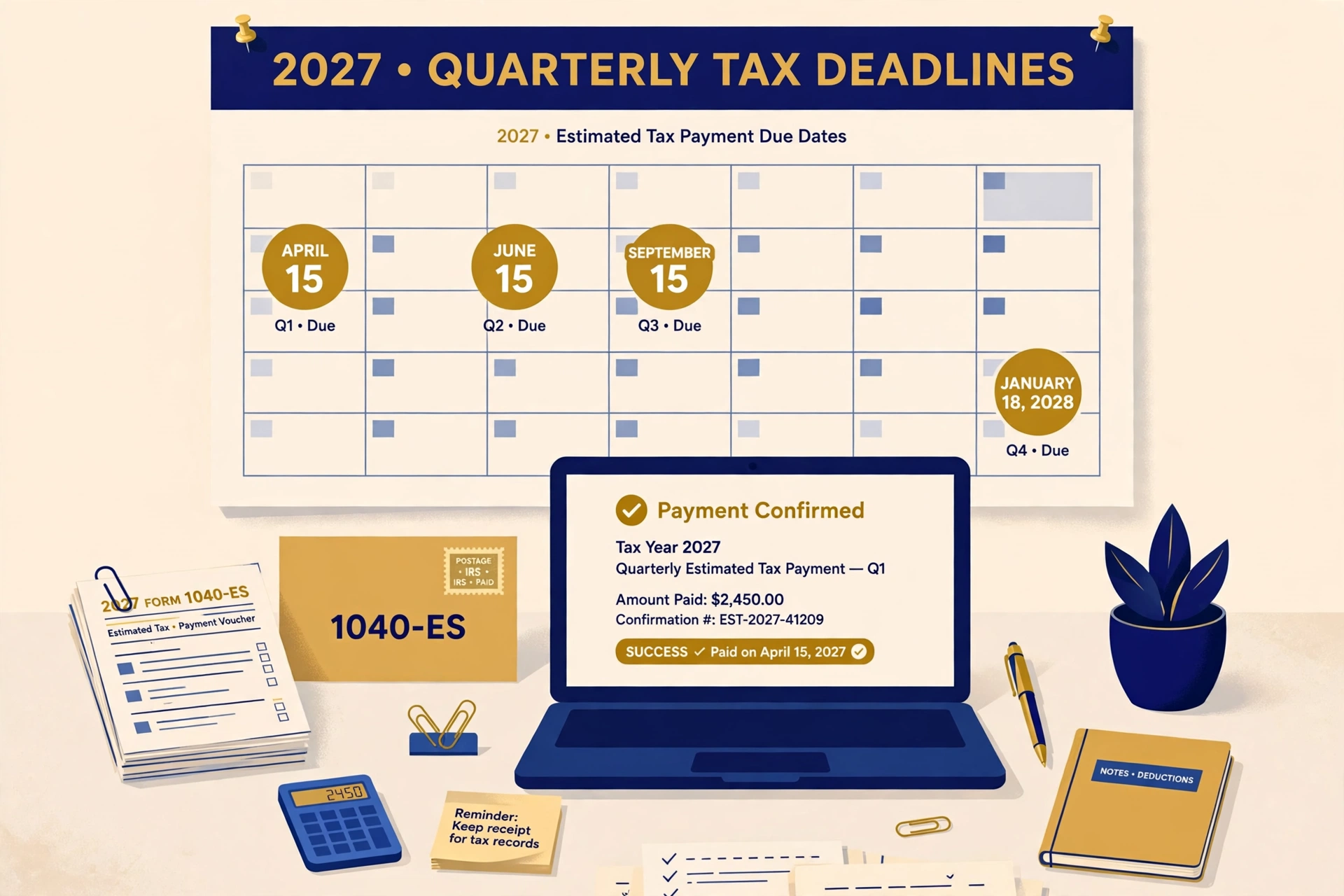
The 2027 Quarterly Tax Deadlines (Full Table)
They’re not actually “quarterly.” The IRS’s payment periods are uneven — the second one covers only two months — which is why so many freelancers get blindsided by the June payment.
| Payment | Income period covered | 2027 deadline |
|---|---|---|
| Q1 | January 1 – March 31, 2027 | Thursday, April 15, 2027 |
| Q2 | April 1 – May 31, 2027 | Tuesday, June 15, 2027 |
| Q3 | June 1 – August 31, 2027 | Wednesday, September 15, 2027 |
| Q4 | September 1 – December 31, 2027 | Tuesday, January 18, 2028 |
Two things to note:
- Q4 2027 moves to January 18, 2028. Normally it’s January 15, but that falls on a Saturday, and the following Monday is Martin Luther King Jr. Day — so the deadline rolls to Tuesday. This is the standard IRS weekend-and-holiday rule.
- You can skip the January payment if you file your 2027 return and pay the full balance by January 31. For freelancers with simple books who finish their taxes early, this collapses four payments into three.
And keep a close eye on June 15: it’s only two months after the April payment, yet it’s the one most commonly missed. Set two reminders.
The Safe-Harbor Rule: How Much to Pay Without Knowing Your Final Bill
Here’s the good news: you don’t have to predict your income perfectly. The IRS’s safe-harbor rule protects you from the underpayment penalty as long as your withholding plus on-time estimated payments reach the smaller of:
- 90% of this year’s total tax, or
- 100% of last year’s total tax — 110% if your prior-year adjusted gross income (AGI) was over $150,000 ($75,000 if married filing separately).
The prior-year option is the one most freelancers actually use, because the number is already printed on last year’s return (Form 1040, the “total tax” line). Divide by four, pay that each deadline, and you’re penalty-safe even if this year turns out much bigger — you’ll still owe the difference in April, but safe harbor protects against the penalty, not the tax itself.
One important caveat: the prior-year safe harbor isn’t available if you didn’t file a return for the prior year or it covered fewer than 12 months. Your first year of self-employment is the trickiest — you’re estimating income you’ve never earned, with no fallback number. Err slightly high; overpayments come back as a refund.
Worked Example: Calculating Four Quarterly Payments
Let’s walk through a concrete example of how to pay quarterly taxes as a freelancer. Meet Maya, a freelance designer in Austin, Texas:
- 2026 total tax (from her filed Form 1040, “total tax” line): $14,000
- 2026 AGI: $78,000 (under $150,000, so the 100% rule applies — no 110% bump)
- Expected 2027 freelance profit: $92,000
Step 1 — Pick the safe-harbor target. Prior-year method: 100% × $14,000 = $14,000.
Step 2 — Divide by four. $14,000 ÷ 4 = $3,500 per payment.
That’s it. Maya pays $3,500 by each deadline:
| Deadline | Amount |
|---|---|
| April 15, 2027 | $3,500 |
| June 15, 2027 | $3,500 |
| September 15, 2027 | $3,500 |
| January 18, 2028 | $3,500 |
If her actual 2027 tax comes out to, say, $16,500 (higher income), she owes the remaining $2,500 when she files in April 2028 — with no underpayment penalty, because her on-time payments hit the safe-harbor target. Had she instead tried to guess 90% of current-year tax and under-shot, she’d owe penalty interest on each shorted installment — calculated separately per quarter, even if the total was eventually paid.
When the prior-year number is the wrong target
Safe harbor is a floor, not a budget. Two situations where you should pay more than the safe-harbor minimum:
- Income dropped sharply this year. If you’re earning much less than last year, the 90%-of-current-year test becomes the cheaper target. Paying last year’s number in full would mean a big interest-free loan to the IRS — fine for your peace of mind, but you’d rather keep the cash. Run the Form 1040-ES worksheet on current-year estimates instead.
- Your state also wants money. The federal safe harbor says nothing about state estimated taxes. Most states with an income tax have their own quarterly schedules — check your state’s revenue department, or the January-April bill will surprise you.
For the broader question of how much of each invoice to keep out of your spending money, see What Percentage Should Freelancers Set Aside for Taxes? (Quick version: 25–30% of gross is the standard starting point.)
How to Pay Quarterly Taxes as a Freelancer Online: 3 Free IRS Options
How to pay quarterly taxes as a freelancer is mercifully the easy part — all three free IRS options take about five minutes:
- IRS Direct Pay (irs.gov/payments): pay directly from your bank account, no signup or account required. Fastest option for a one-off payment.
- EFTPS (eftps.gov): free enrollment that lets you schedule all four payments in advance in one sitting. This is the best option for the “divide by four and forget it” safe-harbor strategy — enroll once, schedule the year, done.
- Your IRS Online Account (irs.gov/account): shows payment history, so you can verify what you’ve already paid — handy when you’re reconciling in April.
Three details that trip people up:
- Select “Estimated Tax” / “1040ES” and the correct tax year. A payment made in January 2028 for Q4 2027 must be marked tax year 2027. Pick the wrong year and your payment lands in the wrong bucket.
- Save the confirmation number for every payment. If the IRS ever claims a payment is missing, that number is your proof.
- File Form 2210 only if you underpaid. If you met safe harbor, you don’t file anything extra — the IRS’s own records verify your payments.
Freelancers with very lumpy income (one giant invoice in November, silence in February) should know about the annualized income installment method on Form 2210, Schedule AI. It can reduce or eliminate a penalty for early quarters when the income simply hadn’t arrived yet — but it’s paperwork-heavy, so it’s a good one to hand to tax software or a pro.
What Happens If You Miss a Payment?
Missing a quarterly payment — or underpaying one — triggers the underpayment penalty, which the IRS computes per quarter at the federal short-term interest rate plus 3 percentage points, resetting every quarter — so there’s no single number to quote — but the mechanism matters more than the rate: the penalty clock starts on each missed installment’s due date, even if you pay the full year’s tax by the April filing deadline.
In other words, catching up in April doesn’t undo the penalty for the quarters you skipped. The penalty is calculated installment-by-installment.
If you already missed one, don’t skip the next: pay what’s due for the current quarter now, and make the missed one up as soon as possible — every day narrows the penalty window. Then lock in the safe-harbor strategy above: once you know how to pay quarterly taxes as a freelancer, next year runs on autopilot.
A Simple System So You Never Miss One
The freelancers who pay on time aren’t more disciplined — they just built a system:
- Separate tax account. Move 25–30% of every payment received into a separate savings account the same day. (How much of each invoice to set aside?)
- EFTPS scheduling. Enroll once and schedule all four estimated payments for the year from your tax account.
- Calendar reminders two weeks before each deadline — April 15, June 15, September 15, and January 18 — in case your income grew and you want to top up beyond the safe-harbor minimum.
- One folder (digital or physical) for confirmation numbers.
That’s the whole machine for how to pay quarterly taxes as a freelancer: money set aside automatically, payments scheduled automatically, one annual check-in with a tax pro. And when filing season arrives, review which forms your clients will send you in January so nothing gets missed.
Frequently Asked Questions
Do I have to pay quarterly taxes in my first year as a freelancer?
Not necessarily. If you had no tax liability in the prior year (and the year covered a full 12 months), you’re generally not required to make estimated payments. That said, the tax bill still comes due in April — understanding how to pay quarterly taxes as a freelancer during year one is still smart so the April bill doesn’t wreck your cash flow.
What if my freelance income is different every quarter — do I still pay four equal amounts?
You can, and safe harbor makes equal payments penalty-proof. But if income is highly uneven, you can vary the amounts — just make sure the cumulative total by each deadline meets the required installment, or use the annualized income installment method (Form 2210, Schedule AI) to match payments to when income actually arrived.
Is the safe-harbor rule the same for state taxes?
No — how to pay quarterly taxes as a freelancer at the state level is a separate question: each state sets its own estimated-tax thresholds and penalty rules. The 100%/110% prior-year and 90% current-year tests are federal-only. If your state has an income tax, check its department of revenue for its own schedule.
Can I just pay my whole estimated tax in one lump sum instead of quarterly?
Yes — when it comes to how to pay quarterly taxes as a freelancer, nothing requires four payments; the IRS only requires the money to arrive on time. You can pay the full year’s estimate with Q1. The downside is cash flow: most freelancers prefer keeping money in their own account until it’s actually due. But if windfall income arrives early (a big project payout in February), paying the full estimate up front is penalty-proof and mentally simple.
Disclaimer: This article is for general informational purposes only and is not tax, legal, or financial advice. Tax rules and figures change; verify current-year deadlines and thresholds at IRS.gov or with a licensed tax professional before making decisions based on this information.