
If you are self-employed, no employer is setting up a retirement plan for you — and no employer is matching your contributions either. That leaves two accounts doing most of the heavy lifting for freelancers: the SEP IRA and the Solo 401(k). Both let you shelter a large chunk of freelance income from current income tax, both grow tax-deferred, and both share the same overall contribution ceiling. So which one should you pick? This SEP IRA vs Solo 401k for freelancers comparison breaks down the numbers so you can decide with confidence.
The short answer: for most solo freelancers, the Solo 401(k) wins — because it lets you contribute as both employee and employer, which means far more savings at low and middle incomes, plus a Roth option and a loan feature the SEP IRA lacks. The SEP IRA wins on simplicity, and it is the only option of the two if you have employees. This guide compares SEP IRA vs Solo 401k for freelancers side by side, with real 2026 limits and worked examples, so you can decide on numbers rather than vibes.
In This Article
What Each Account Actually Is
A SEP IRA (Simplified Employee Pension) is an IRA that accepts employer contributions only. As a freelancer, you are your own employer, so you fund it from business profits. There is no employee deferral, no Roth version at most providers, and no loan feature — but setup takes minutes, there is no annual IRS filing for a basic plan, and you can open and fund it as late as your tax filing deadline, including extensions.
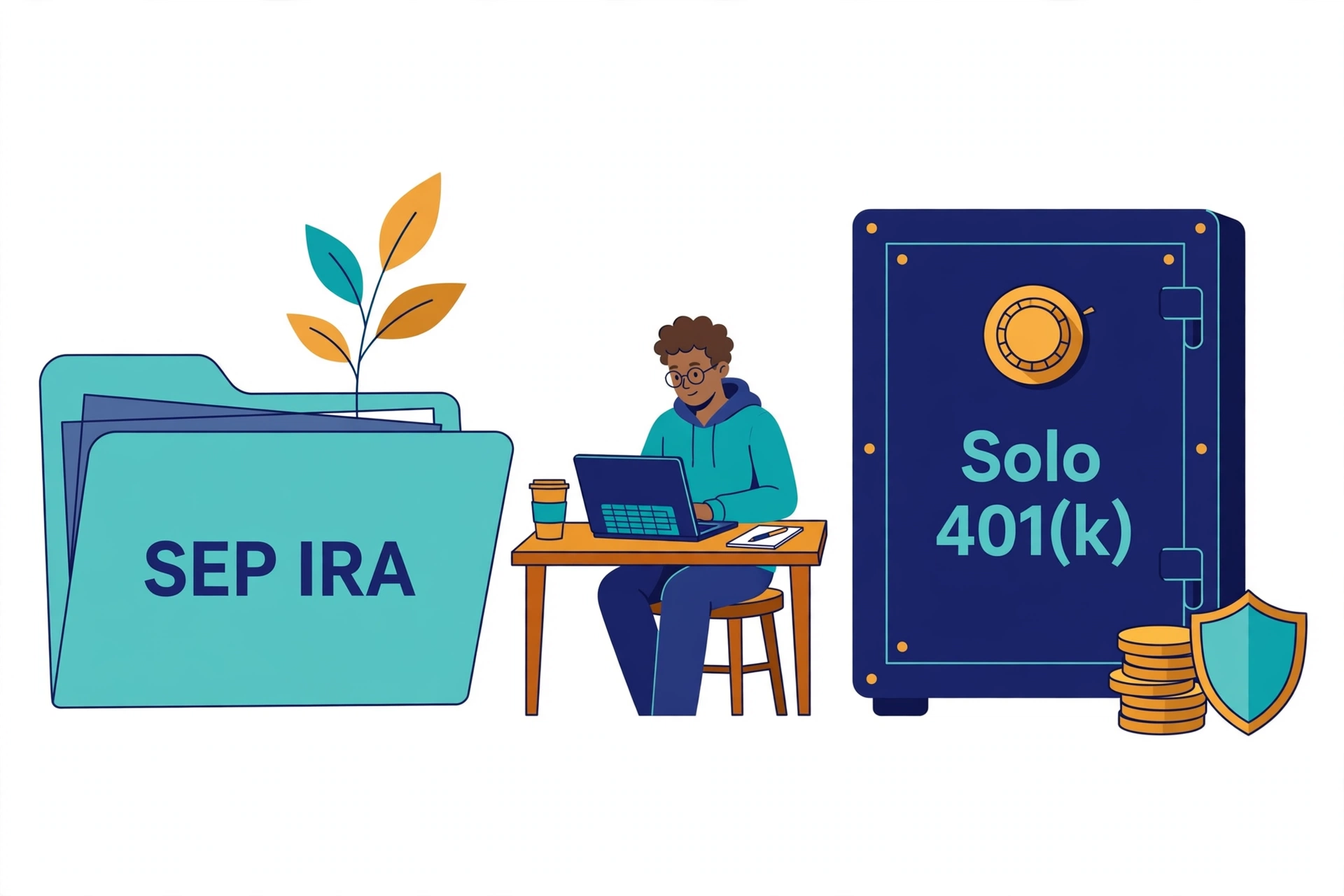
A Solo 401(k) — also called an Individual 401(k) or Self-Employed 401(k) — is a real 401(k) plan designed for a business with no full-time employees other than the owner’s spouse. It has two contribution buckets: an employee elective deferral (the same kind of contribution a W-2 worker makes from a paycheck) plus an employer profit-sharing contribution. That two-bucket structure is the entire reason it usually beats the SEP IRA. That structure is the core of the SEP IRA vs Solo 401k for freelancers comparison.
The eligibility rule is the first decision filter:
- Have employees (other than your spouse)? The Solo 401(k) is off the table. Use a SEP IRA — but know that you must contribute the same percentage of pay for every eligible employee as you contribute for yourself.
- Truly solo? You can choose either, and the math below usually favors the Solo 401(k).
SEP IRA vs Solo 401k for Freelancers at a Glance (2026 Limits)
| Feature | SEP IRA | Solo 401(k) |
|---|---|---|
| Who can use it | Any self-employed person, with or without employees | Only with no full-time employees (spouse excepted) |
| Contribution types | Employer only | Employee deferral + employer profit-sharing |
| 2026 overall cap | $72,000 | $72,000 ($80,000 at age 50+, $83,250 at ages 60–63) |
| 2026 employee deferral | Not available | $24,500 ($32,500 at age 50+, $35,750 at ages 60–63) |
| Employer contribution | Up to 25% of compensation | Up to 25% of compensation |
| Catch-up contributions (age 50+) | No | Yes: $8,000 ($11,250 at ages 60–63) |
| Roth option | Effectively no at most providers | Yes, on the employee side if the plan supports it |
| Loans | No — loans are not permitted from any IRA | Yes, up to 50% of the balance, max $50,000, if the plan allows |
| Annual IRS filing | None for a basic SEP | Form 5500-EZ once plan assets exceed $250,000 |
| Setup complexity | Very simple | Moderate — a plan document is required |
One important note on timing: the IRS had not yet announced official 2027 contribution limits as of October 27, 2026. Early projections point to roughly a $25,500 deferral and a $75,000 overall cap, but those are estimates, not IRS figures. Every limit in this SEP IRA vs Solo 401k for freelancers guide is therefore the confirmed 2026 figure — check the IRS retirement plan contribution limits for the latest official numbers, and check back for the 2027 update once the IRS announces it, expected in November 2026.
SEP IRA vs Solo 401k for Freelancers: Why the Solo 401(k) Usually Lets You Save More
Here is the math that decides most comparisons. A SEP IRA contribution is capped at 25% of your compensation — and for a sole proprietor, the self-employment-tax adjustment shrinks that to roughly 20% of net earnings, or about 18.6% of Schedule C profit as a working shortcut. (The exact figure comes from the IRS Publication 560 worksheet; the shortcut is close enough for planning.)
A Solo 401(k) adds the employee deferral on top of that same employer share. The deferral does not depend on the 25% formula at all — you can defer up to $24,500 (2026) as long as you have at least that much in net earnings.
Worked Example: $60,000 in Schedule C Profit (Under Age 50)
- SEP IRA: about $60,000 × 18.587% = ~$11,152
- Solo 401(k): $24,500 employee deferral + ~$11,152 employer share = ~$35,652
The Solo 401(k) shelters more than three times as much at this income level. At a 22% marginal federal income-tax rate, the Solo 401(k) contribution saves roughly $7,843 in federal income tax versus about $2,453 for the SEP IRA — before state tax, and before any interaction with the qualified business income deduction, which a tax professional should check for your situation.
Worked Example: $100,000 in Schedule C Profit (Under Age 50)
- SEP IRA: about $100,000 × 18.587% = ~$18,587
- Solo 401(k): $24,500 + ~$18,587 = ~$43,087
Again, the Solo 401(k) wins by exactly the $24,500 deferral. That gap is the whole story at low and middle incomes: the SEP IRA can never close it, because it has no employee bucket.
When the Gap Closes: High Incomes
At very high incomes the two plans converge, because both hit the same $72,000 overall cap. At $300,000 in Schedule C profit, the employer share alone is roughly $56,909 — so a Solo 401(k) would be $56,909 + $24,500 = $81,409 before the cap, which gets cut back to $72,000. The SEP IRA at that income is ~$56,909. The Solo 401(k) still wins, but only by about $15,091, not $24,500 — and a freelancer earning that much may reasonably trade a smaller edge for the SEP IRA’s simplicity.
The crossover lesson: the lower your profit, the bigger the Solo 401(k) advantage. If you earn under roughly $150,000, the Solo 401(k) is usually the clear winner on contribution room alone.
The Roth Difference: Tax-Free Growth vs. a Deduction Today
A SEP IRA contribution is pre-tax: it lowers your taxable income now, grows tax-deferred, and is taxed as ordinary income when withdrawn in retirement. (SECURE 2.0 authorized Roth SEP IRAs, but most providers do not offer them yet, so treat the SEP IRA as pre-tax-only in practice.)
A Solo 401(k) lets you split the employee deferral between pre-tax and Roth if your plan provider supports a Roth option. Roth deferrals give you no deduction today, but qualified withdrawals in retirement are tax-free. That matters most if:
- You are early in your career and expect to be in a higher tax bracket later.
- You are in a low-income year — a slow freelance year is a cheap time to buy Roth space.
- You want tax diversification: some pre-tax money, some Roth money, so you can manage your tax bracket year by year in retirement.
Note that employer profit-sharing contributions to a Solo 401(k) are always pre-tax; only the employee deferral can go Roth. And if you are age 50 or older, the Solo 401(k) also offers catch-up contributions — an extra $8,000 in 2026, or $11,250 if you are 60 to 63 — that the SEP IRA simply does not have.
Loans, Paperwork, and Other Practical Differences
Loans. A Solo 401(k) can allow you to borrow up to 50% of your vested balance, capped at $50,000, and repay yourself with interest. A SEP IRA cannot be borrowed against at all — any attempt to pledge IRA assets is treated as a distribution. For freelancers with irregular income, that loan feature is a genuine emergency valve, though it should never be the reason you choose the account. When you weigh SEP IRA vs Solo 401k for freelancers, treat the loan feature as a bonus, not the deciding factor.
Paperwork. The SEP IRA is the simplest retirement plan the IRS offers: open an account, adopt the IRS model agreement (Form 5305-SEP), and contribute. No annual filing. The Solo 401(k) requires a plan document, and once plan assets exceed $250,000 you must file Form 5500-EZ each year. That filing is short, but it is a real annual obligation — miss it and penalties apply.
Deadlines. This is the SEP IRA’s best feature. A Solo 401(k) must generally be established by December 31 of the tax year, and employee deferrals generally must be elected by December 31 as well. A SEP IRA, by contrast, can be opened and funded as late as your tax filing deadline, including extensions — for the 2026 tax year, that means October 15, 2027 if you file an extension. Employer contributions to a Solo 401(k) share that extended deadline, but the plan itself must already exist. If you are reading this in January and have no plan yet, the SEP IRA may be your only way to still save for the prior year.
Withdrawals and RMDs. Both accounts follow the same basic rules: withdrawals before age 59½ generally trigger a 10% early-withdrawal penalty on top of income tax (with exceptions), and required minimum distributions from pre-tax money generally begin at age 73. Roth Solo 401(k) money is no longer subject to RMDs during the owner’s lifetime under SECURE 2.0 — another point in the Solo 401(k)’s favor if Roth matters to you.
Which One Should You Choose? A SEP IRA vs Solo 401k for Freelancers Decision Framework
Choose the Solo 401(k) if you:
- Are a solo freelancer with no employees (other than a spouse)
- Want to maximize contributions, especially on profits under ~$150,000
- Want a Roth option or the age-50+ catch-up
- Value the loan feature as a safety valve
- Can handle a plan document and, eventually, a Form 5500-EZ
Choose the SEP IRA if you:
- Have employees and need a plan that covers them
- Missed the December 31 Solo 401(k) setup deadline and want to save for the prior year
- Want the simplest possible setup with zero annual filings
- Earn enough that the 25% employer share alone meets your savings goal
- Prefer to decide your contribution after your tax return is done — the extended deadline is genuinely valuable for freelancers with lumpy, late-arriving income
A common middle path: start with a SEP IRA in your first year while income is uncertain, then switch to a Solo 401(k) once your profit is steady and you want the larger contribution room. You cannot contribute to both a SEP IRA and a Solo 401(k) for the same business in a way that doubles your limit — the overall $72,000 cap and the shared compensation base still apply — so treat it as a switch, not a stack. If you already have a SEP IRA and open a Solo 401(k), talk to your provider about how the two interact before contributing to both in the same year.
And remember the boring-but-essential step either way: keep retirement money in a separate business account workflow, so contributions come from business funds and your records stay clean. The account choice matters less than actually funding it — a SEP IRA you fund beats a Solo 401(k) you never get around to opening.
Related reading: how retirement contributions fit into the 25–30% you set aside for taxes · retirement contributions lower income tax, not self-employment tax
FAQ
Can I contribute to both a SEP IRA and a Solo 401(k) in the same year?
You can have both accounts, but you cannot double-dip on limits. The overall defined-contribution cap ($72,000 in 2026) and the compensation base are shared, and coordinating contributions across two plans for the same business is easy to get wrong. Most freelancers weighing SEP IRA vs Solo 401k for freelancers should pick one plan per business and stick with it; get professional advice before funding both in the same year.
Does a Solo 401(k) reduce my self-employment tax?
No. Retirement contributions reduce your income tax, not your self-employment tax. Self-employment tax is calculated on your net earnings before retirement contributions — see how the 15.3% self-employment tax is calculated for the full breakdown. This is one of the most common freelancer misconceptions, and it applies equally to SEP IRAs and Solo 401(k)s.
Can I have a Solo 401(k) if I also have a W-2 job with a 401(k)?
Yes, but your employee deferral limit is shared across all 401(k) plans — $24,500 total in 2026, not $24,500 per plan. Your employer contributions under the Solo 401(k) are separate, but the overall $72,000 cap applies per unrelated employer. Tell your Solo 401(k) provider about the W-2 plan so you do not over-contribute.
What happens to my Solo 401(k) if I hire my first employee?
You can no longer maintain a Solo 401(k) once you have full-time employees other than your spouse — the plan must generally be terminated or converted to a regular 401(k). A SEP IRA, by contrast, is designed to cover employees from the start. If hiring is on your horizon, factor that transition into your choice.
Bottom line: in the SEP IRA vs Solo 401k for freelancers comparison, the Solo 401(k) usually comes out ahead on contribution room, Roth flexibility and loans — unless you have employees or missed the December 31 setup deadline, in which case the SEP IRA is the right tool. Either way, the best plan is the one you actually fund.
This article is for general information only and is not tax, legal, or financial advice. Retirement plan rules depend on your business structure, income, and individual situation, and contribution limits change annually — consult a licensed tax or financial professional before opening or funding a plan.