
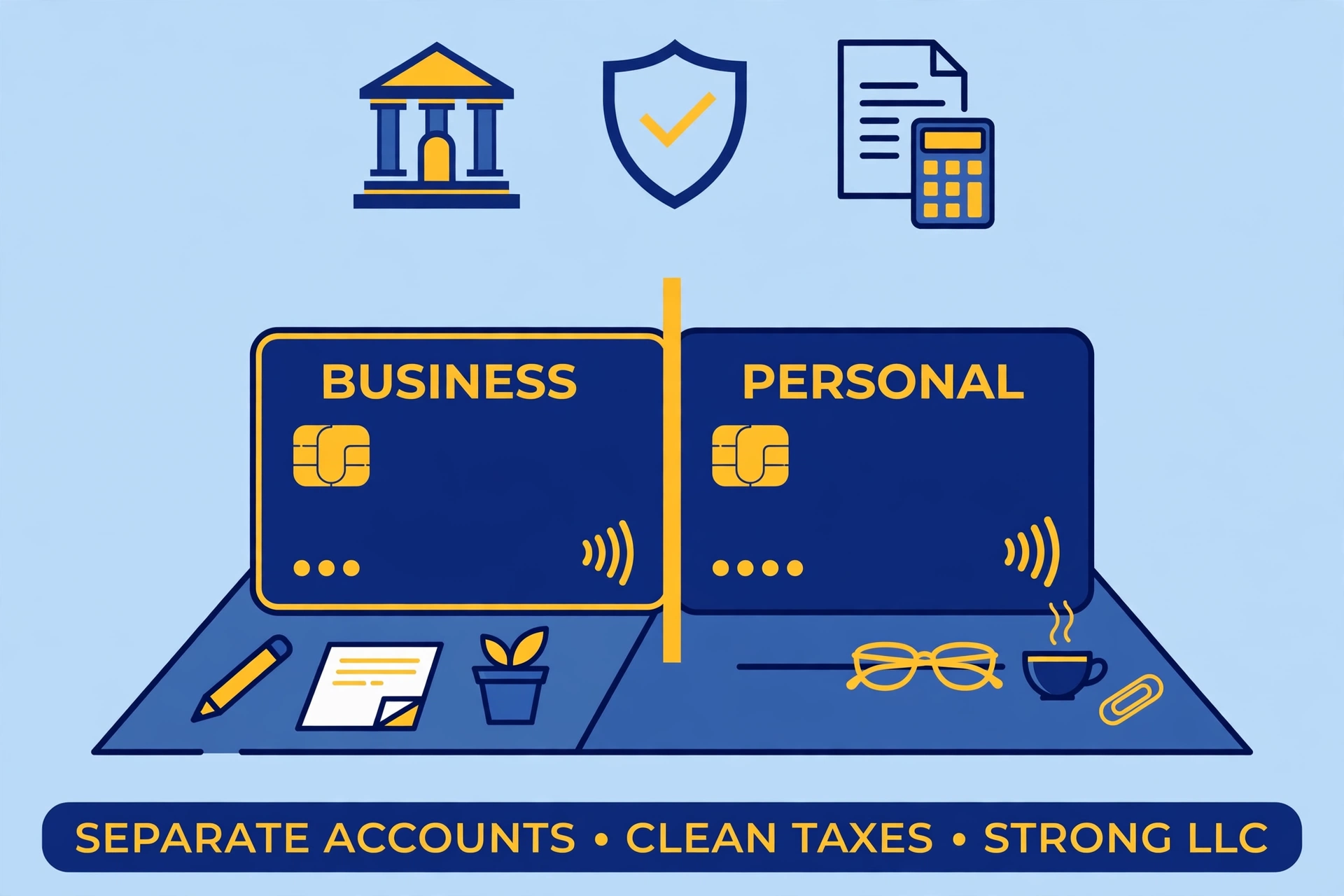
If you’re a freelancer, your money probably arrives in a messy stream: a Stripe payout here, a PayPal transfer there, a client check, a Venmo payment for a quick job. And if all of it lands in the same checking account you use for groceries and rent, you’re not alone. Most new freelancers start exactly that way.
So, do freelancers need a separate bank account? The short answer: the law doesn’t force you to open one — but running your business through your personal account is one of the most expensive “free” shortcuts in freelancing. It costs you time at tax season, puts deductions at risk, and can even weaken the legal protection of an LLC. Here’s the full case for separating your money, plus exactly how to do it.
Table of Contents
The Short Answer: Legally Optional, Practically Essential
No federal law requires a sole proprietor to open a separate business bank account. That’s because a sole proprietorship isn’t a separate legal entity — you are the business. Your business income is your personal income, reported on Schedule C of your tax return, and the IRS taxes it the same way whether it sat in a personal account or a business one.
But “not legally required” and “a good idea” are very different things. The IRS does require you to keep adequate records of every item of income and every deduction you claim, and a dedicated business account is the simplest, cheapest way to produce those records. The U.S. Small Business Administration recommends opening a business bank account as soon as you start accepting or spending money as a business.
5 Reasons to Separate Your Business and Personal Money
1. Tax Season Gets Dramatically Easier
Picture two Aprils. In the first, you open a single bank statement and start sorting: Was that $47 at the office supply store business or personal? Was the $1,200 deposit a client payment or a reimbursement from a friend? Multiply that detective work across hundreds of transactions, and you’ve bought yourself a miserable weekend — or a hefty accountant bill.
In the second April, you hand your accountant (or your tax software) one business account statement. Income is income. Expenses are expenses. Deductions you might otherwise have missed — software subscriptions, a coworking day pass, that domain renewal — are sitting in plain sight instead of buried between grocery runs.
A separate account doesn’t replace receipts and invoices. The IRS can still ask you to prove the business purpose of an expense. But it turns a forensic excavation into a simple review.
2. You Stop Missing Deductions
Freelancers leave real money on the table every year through deductions they simply forget. When business spending is mixed with personal spending, small recurring charges are the first things to vanish: the $12-a-month design tool, the $9 stock-photo subscription, the annual business license fee.
With a dedicated account, those charges form a visible pattern. Reviewing twelve monthly statements takes minutes, and every deductible expense announces itself. For the full rundown of what you can write off, see our freelancer tax deductions guide (coming soon).
3. You Protect Your LLC (If You Have One)
This one matters more than most freelancers realize. If you operate as an LLC, the whole point is the liability shield: your personal assets are supposed to be separate from your business’s debts and lawsuits. But that shield isn’t automatic — courts can “pierce the corporate veil” if you treat the LLC like an extension of yourself.
Commingling funds is one of the classic triggers judges look for. Paying your mortgage from the LLC’s account, or running client payments through your personal checking, makes it easy for a creditor to argue that the LLC was never really separate from you.
Note the flip side: if you’re a sole proprietor, you have no liability shield to protect — your personal assets are already exposed to business debts. That’s a separate reason to think carefully about your business structure.
4. Your Bank Can Close Your Personal Account
Here’s a risk almost nobody warns new freelancers about: most personal deposit-account agreements prohibit regular commercial activity. If your personal account starts receiving a high volume of business deposits — client checks made out to a business name, or payouts from Stripe, Square, or PayPal — your bank may flag it, freeze it, or close it outright.
Losing access to your main account mid-project, with client payments bouncing and bills autopaying into a void, is a crisis you don’t need. A business account is built for exactly this traffic.
5. You Get a Clear Picture of Whether You’re Actually Profitable
When everything flows through one account, your “business performance” is a feeling, not a number. A healthy month of client work can mask the fact that your expenses quietly ate most of it — or a slow month can feel catastrophic when your buffer is actually fine.
A separate account gives you a real profit-and-loss view at a glance: money in, money out, balance over time. That clarity feeds every other financial decision, from what percentage of income freelancers should set aside for taxes to whether you can afford to raise your rates or turn down a bad client.
Does a Separate Account Change How Much Tax You Pay?
No. If you’re a sole proprietor, your income is taxed the same way regardless of which account holds it, and a legitimate business expense is deductible on Schedule C even if you accidentally paid for it from your personal account — as long as you can document it. What separation changes is your ability to prove your numbers: in an IRS examination, unidentified deposits can be treated as taxable income and undocumented expenses disallowed. A clean account protects the deductions and income figures you’ve already got right.
The 3-Account System: The Setup That Actually Works
One business checking account is the minimum. But the setup most successful freelancers land on has three buckets:
| Account | Purpose | Rule |
|---|---|---|
| Business checking | All client income lands here; all business expenses are paid from here | Never pay personal bills directly from this account |
| Tax savings account | A slice of every payment, reserved for quarterly estimated taxes | Transfer 25–30% of each payment as soon as it arrives (a rule of thumb, not a tax rate) |
| Personal checking | Your “salary” and everyday spending | Pay yourself a regular transfer — an owner’s draw — instead of dipping in randomly |
Here’s how it works in practice. Suppose you land a $4,000 project payment:
- $4,000 arrives in business checking.
- $1,000 (25%) moves immediately to the tax savings account.
- $3,000 stays available; you transfer a fixed “paycheck” to your personal account — say $2,200 — and leave the rest as a business buffer for slow months.
That $1,000 tax transfer is the habit that prevents the classic freelancer disaster: spending the whole payment in January and discovering the quarterly tax bill in April. The IRS expects estimated tax payments four times a year — see how to pay quarterly estimated taxes as a freelancer — and the underpayment penalty accrues from each missed deadline.
A Worked Example: One Year, Two Freelancers
Maya and Jordan both earn $72,000 in freelance income in a year. Maya runs everything through one personal account. Jordan uses the 3-account system above.
Maya’s April: She spends a weekend sorting 400+ mixed transactions, pays her accountant an extra $350 for the cleanup, and can’t confidently reconstruct about $600 in deductible software subscriptions. She also forgot to reserve for taxes and owes an estimated payment she hasn’t saved for.
Jordan’s April: He exports one business statement, confirms his deductions in an evening, and files with a tax savings account that already holds roughly $18,000 (25% of $72,000) for the year’s estimated payments. His accountant charges the standard rate because there’s nothing to untangle.
The difference isn’t talent or income. It’s plumbing. Jordan’s system cost him maybe an hour to set up; Maya’s shortcut cost her a weekend, $350, and $600 in lost deductions — roughly $950 in the first year alone, before counting the stress.
How to Open a Separate Business Account (Step by Step)
Step 1: Decide whether it needs to be a “business” account
You have two legitimate options:
- A second personal checking account, used only for business. The simplest move for a sole proprietor operating under your own name — free at many banks, and it creates the clean paper trail you need. The catch: it doesn’t solve the “personal account agreement prohibits business activity” problem, and you can’t deposit checks made out to a business name.
- A true business checking account. Required if you have an LLC or corporation (the account must be in the entity’s name), and recommended if you operate under a business name or accept checks payable to that name. Many online business accounts have no monthly fee.
Either option beats one mixed account. The business account is the stronger choice if you plan to grow.
Step 2: Gather your documents
For a sole proprietor, banks typically ask for your Social Security number (or EIN) and a government ID. If you operate under a business name (a DBA — “doing business as”), bring the DBA registration. For an LLC, you’ll need the entity’s EIN and formation documents.
Step 3: Set up the money flow
Once the account is open:
- Point every payment platform (Stripe, PayPal, direct deposit) at the business account.
- Move your business subscriptions and recurring expenses to the business debit card.
- Open the tax savings account and set a recurring habit: transfer your tax percentage the day money arrives, not at month-end.
- Schedule a regular owner’s draw to your personal account — weekly, biweekly, or monthly. A fixed rhythm turns volatile freelance income into a steady paycheck.
Step 4: Keep a paper trail beyond the statement
A bank statement shows that money moved, not why. Keep invoices, receipts, and contracts organized by tax year. The IRS generally advises keeping records at least until the period of limitations expires — typically three years from the date you file the return.
What About a Separate Credit Card?
The same logic applies: one card used only for business purchases gives you a second clean record. It doesn’t have to be a formal business credit card — a dedicated personal card used exclusively for business works just as well for bookkeeping. Just remember that business expenses on a personal card are still your personal liability.
FDIC Insurance: A Quiet Bonus of Separation
One overlooked benefit: FDIC insurance covers deposits up to $250,000 per depositor, per insured bank, per ownership category. A business entity’s accounts are insured separately from the owner’s personal accounts at the same bank — so an LLC with $200,000 in a business account and $200,000 in a personal account at the same bank has both balances fully covered. (For a sole proprietor, business and personal accounts share your single-owner category, so this bonus applies mainly to entities.)
Common Objections, Answered
“I’m too small for this — I only have a few clients.”
Small is exactly when it’s easiest. Opening the account takes under an hour, and untangling two years of mixed transactions later takes far longer than starting clean now.
“Won’t a business account cost me monthly fees?”
Many online business checking accounts charge no monthly fee, and several traditional banks waive fees with a minimum balance or activity level. Compare that to one missed deduction or one extra accountant hour, and the math is usually obvious.
“Can I just use accounting software instead?”
Software helps you categorize transactions, but it can’t un-mix money that’s already mixed. The account creates the clean data; software organizes it. Use both.
“I already mixed everything this year. Is it too late?”
No. Open the account now and run all new income and expenses through it. For the months already mixed, set aside one afternoon to sort transactions while the details are still fresh.
Frequently Asked Questions
The Bottom Line: Do Freelancers Need a Separate Bank Account?
Do freelancers need a separate bank account? Strictly speaking, no — but freelancers who want clean taxes, protected deductions, a defensible LLC, and a clear view of their own profitability treat it as non-negotiable. It’s one of the cheapest, highest-return moves in freelance finance: an hour of setup that pays off every single tax season for the rest of your career.
Open the account this week. Point your payment platforms at it. Move your tax percentage the day money arrives. Future-you, staring down April with a single clean statement instead of a year’s worth of detective work, will be grateful.
Disclaimer: This article is for general information only and is not tax, legal, or financial advice. Tax rules and banking regulations change, and your situation may differ. Consult a licensed tax professional, accountant, or attorney before making decisions about your business structure, bank accounts, or tax filings.